
'Personal income tax collections have been high on account of impressive advance tax mop-up.'

At the end of May, out of 26,500 outlets about 60 per cent showrooms and 80 per cent workshops were operational across the country.

'India is in a slowdown which most of us have not seen in our living memory.'

China's GDP took the worst hit since the disastrous Cultural Revolution in 1976, plummeting by 6.8 per cent in the first quarter of 2020 as the country took unprecedented measures to fight the coronavirus pandemic that brought the world's second largest economy to a standstill. China's gross domestic product stood at 20.65 trillion yuan (USD 2.91 trillion, approx) in the first quarter of 2020 amid the Covid-19 impact, down 6.8 per cent year on year, China's National Bureau of Statistics (NBS) said on Friday.
Nomura expects the fiscal deficit target of 3.5 per cent for 2016-17 to be met and to be consolidated further to 3 per cent of GDP in 2017-18.
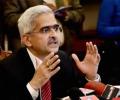
Reserve Bank Governor Shaktikanta Das has pitched for policy support from all sides -- fiscal, monetary and sectoral -- to nurture recovery of the economy hit by the second wave of the coronavirus pandemic. The dent on economic activity due to the second wave of the pandemic during April-May necessitated continuation of monetary measures to support the process of economic recovery to make it durable, Das had said while participating in the meeting of the Monetary Policy Committee (MPC) earlier in the month. "Overall, the second wave of COVID-19 has altered the near-term outlook, and policy support from all sides - fiscal, monetary and sectoral - is required to nurture recovery and expedite return to normalcy," Das said, as per the minutes of the meeting released on Friday.

Nearly 25 million jobs could be lost worldwide due to the coronavirus pandemic, but an internationally coordinated policy response can help lower the impact on global unemployment, according to a UN agency. In its preliminary assessment report titled 'COVID-19 and world of work: Impacts and responses', the International Labour Organization (ILO) calls for urgent, large-scale and coordinated measures across three pillars -- protecting workers in the workplace, stimulating the economy and employment, and supporting jobs and incomes.
.jpg)
Narrowing of the current account deficit will help arrest depreciation of the rupee and ease inflation concerns, industry groups said.

Growth in emerging market and developing economies will slow to 4.4 per cent in 2014, before rising to 5.0 per cent in 2015, it said.

Long-term capital gains tax may be scrapped and the burden of dividend distribution tax could perhaps be shifted from companies to shareholders. Also, the Budget could provide income tax relief for the salaried classes, while proposing tax sops for small, medium and micro enterprises.
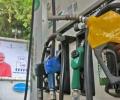
'The question often being asked is whether the demand for petrol and diesel is price inelastic?' asks Arun Balakrishnan, former chairman and managing director, Hindustan Petroleum.

New series points to a sharp recovery since FY14.
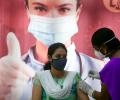
'I'll give it to the vaccine manufacturers without guarantees, take the payment in advance and give me the supplies.' 'The moment you give me one lot of supply, I'll give you more.'
Experts disagree with the idea and the Reserve Bank of India (RBI), which has the sole right to print money, is not comfortable with it as well.

Silverline seems symptomatic of how Kerala -- its claimed education, awareness and all -- overlooks its real problems, notes Shyam G Menon.

India must be prepared for a big, fat fuel import bill in FY23 - barring any further avatars of the Covid virus - as refiners crank up runs, or crude processing rates, to meet the growing demand for fuels, and crude prices soar. Capacity additions by an Indian state-run refiner will reinforce the need for foreign crude. Demand for all fuels is expected to increase by 3-8 per cent next fiscal from 2021-22, reaching pre-pandemic levels, according to analysts and industry experts.

Currently, the spend on R&D as a percentage of GDP is just 0.9%

Twelve of the 21 economists polled doubted whether the government could roll out the tax before the next fiscal year begins in April.

The derivatives (futures and options) are not treated as capital asset and the income arising from the transfer of the derivatives is treated as business income and liable for normal rate of tax for domestic investors, an official statement said on Saturday, clarifying the stand of tax authorities on gains made from derivatives trading.

The immediate need is to put more money in the hands of agriculture-based and rural households to improve their purchasing power, says S Mahendra Dev.
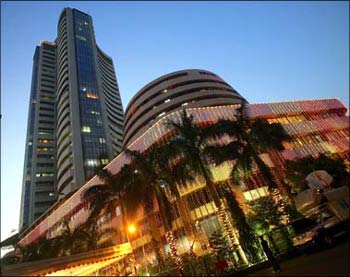
The longest winning streak was the six years between 2002-2007 when the Nifty moved from around 1,000 to over 6,000.

India's GDP growth has slowed down to 7.8 per cent for January-March quarter from 9.4 per cent in corresponding period of the previous year.

'Event management can distract from, but not permanently mask, execution failures,' points out Rathin Roy, director, National Institute of Public Finance and Policy.

The protests brought home the fact that the Sri Lankan public is in no mood for halfway measures, as voices against Rajapaksa 'family rule' and 'securitisation' of the civilian administration began sidestepping the more critical economic crisis, affecting the nation and afflicting the individual, observes Sri Lanka watcher N Sathiya Moorthy.

The events of the last few years shows that pessimism about where we have arrived and where we are headed is justified, asserts Aakar Patel.

Nobody bothered to articulate the upsides; instead, the four-year tour of duty and denial of life-long pensions got played up.
Job-seekers for government and related opportunities found that their future was at risk, points out Shreekant Sambrani.

The G-20 leaders under the chairmanship of Saudi Arabia's King Salman held an extraordinary video conference in which they resolved to use all available policy tools to minimise the economic and social damage from the pandemic that has killed over 21,000 people and infected more than 470,000 globally.

On the revenue front, the finance ministry was expecting higher proceeds from non-tax revenue.
Moody's expect RBI to hold policy 'repo' rate steady to have a neutral stance in this growth
Finance secretary Ajay Bhushan Pandey on Sunday hinted that the government was working on another stimulus package but he refrained from giving a timeframe.
'The current budgetary practice of shifting expenditures off-balance sheet in order to be seen to be meeting fiscal targets should be discontinued; additional fiscal stimulus would be imprudent; individual income tax rates should not be cut; GST rates should not be raised now,' advise Arvind Subramanian and Josh Felman.
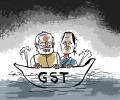
Rates may be raised from 5 per cent to 8 per cent and 12 per cent to 15 per cent. The Council can explore possibility of merger of slabs to bring down the number of slabs to three. The Central GST collection fell short of the Budget Estimate by nearly 40 per cent during the April-November period of 2019-20

Rajnath Singh outlined the major measures and initiatives taken by the Modi government to provide basic needs to people of India, including providing homes, building toilets to end open defecation, electricity, cooking gas and focusing on infrastructure development.
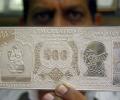
The Economic Survey states that the rationalisation and reprioritisation of subsidies through better targeting would play a vital role in fiscal consolidation and in targeting expenditure more towards inclusive development.

Bangladesh might overtake India this year by per capita income in nominal dollars, but it is not yet close to becoming South Asia's economic powerhouse anytime soon, T N Ninan points out.
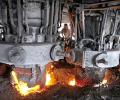
The non-oil, non-finance sector of the economy is under severe stress.

Can the finance minister manage our expectations, asks A K Bhattacharya.

Indian service sector output broadly stabilised in September but remained in the contraction zone as incoming new business fell moderately due to the damaging impact of the pandemic on demand, leading to more job losses.
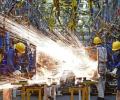
The country's manufacturing sector activity recorded another sharp deterioration in business conditions during May as new orders placed with producers continued to fall after April's record contraction, leading firms to cut jobs at the quickest pace on record, a monthly survey said on Monday.
For India Inc, latest GDP figures signal a turnaround.
 © 2026 Rediff.com - Advertise with us - Disclaimer - Privacy Policy - Sitemap - Feedback - About us - Terms of use - Grievances